
informational 6 min read
Colosseum History: Gladiators, Construction and Why It Still Stands
Updated September 12, 2026
Short answer: the Colosseum was commissioned by Emperor Vespasian in the early 70s AD as a free public gift to Rome, funded by spoils from the conquest of Judaea, and opened by his son Titus in 80 AD with 100 days of games. It stayed in active use for gladiatorial contests and animal hunts for roughly four centuries, then fell into disrepair from earthquakes and stone-robbing before 18th-century preservation efforts — and later archaeological restoration — brought it to the state visitors see today.
Why it was built
After the excesses associated with Nero’s reign, the Flavian emperors wanted a public monument that gave something back to Rome rather than to an emperor’s private pleasure. Vespasian commissioned the amphitheater on the site of Nero’s drained private lake, funded largely by the spoils of the Roman victory in the Jewish War, including the sack of Jerusalem in 70 AD. It was designed as a free, city-owned venue — a deliberate contrast to Nero’s private excess.
Construction and opening
Construction ran through the 70s AD under Vespasian and his son Titus, who inaugurated the finished amphitheater in 80 AD with 100 days of games: gladiatorial contests, staged hunts of exotic animals, and — in its earliest years, before the underground hypogeum was built — even mock naval battles using a flooded arena floor. A third Flavian emperor, Domitian, completed the upper tier and added the hypogeum, the network of underground tunnels and lift mechanisms that let animals and fighters appear from beneath the arena floor.
What happened inside
For roughly four centuries, the Colosseum hosted gladiatorial combat, public animal hunts (venationes), and executions staged as public spectacle, holding an estimated 50,000 to 80,000 spectators depending on the event and seating arrangement. Gladiatorial games were formally ended in the early 5th century, while animal hunts continued into the 6th century, after which the building’s original purpose ended.
Why it fell into ruin
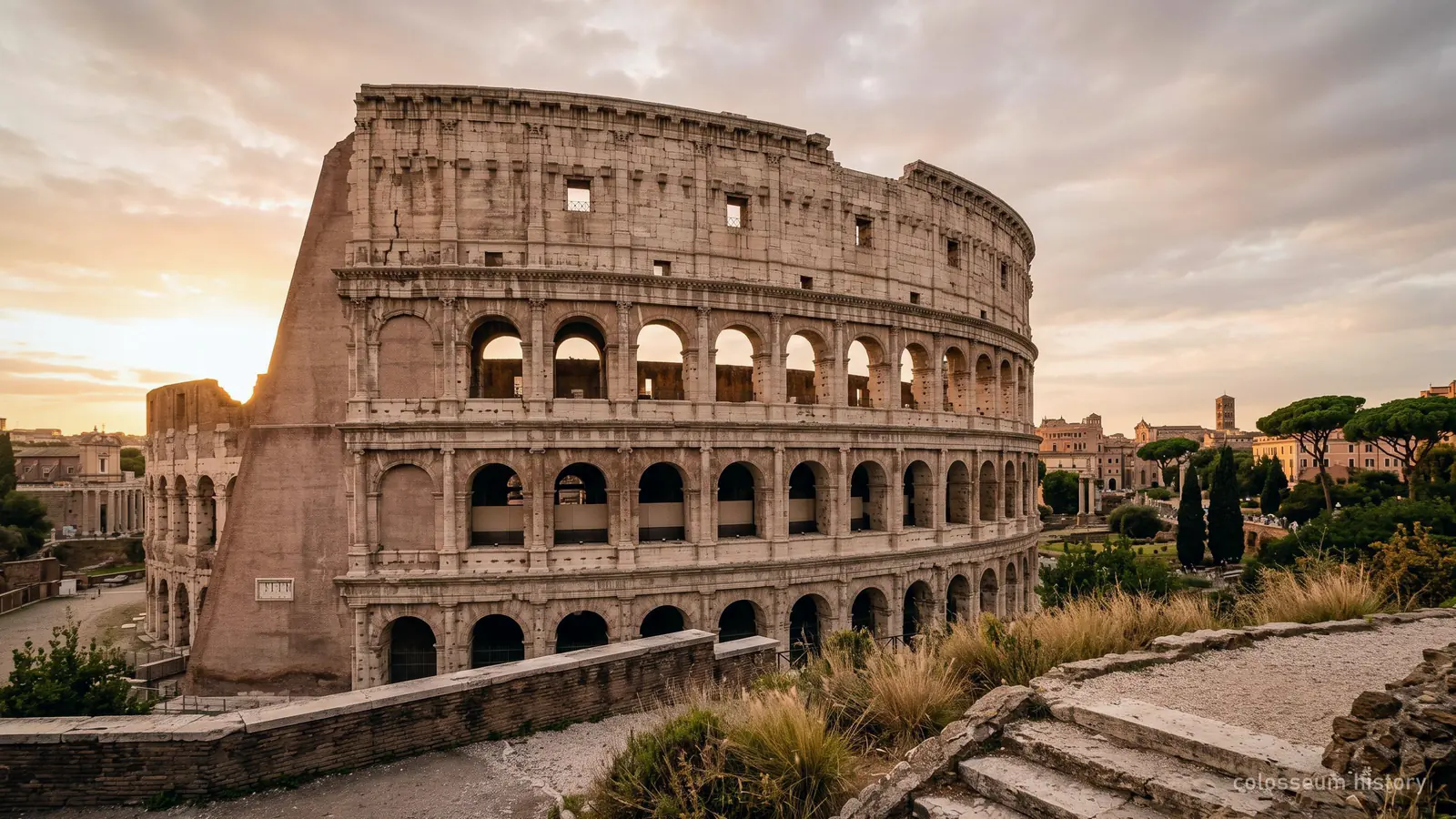
Rome’s decline left the Colosseum without the resources or purpose that had maintained it. Earthquakes — most damagingly in 1349 — collapsed part of the outer ring. For centuries afterward, its stone and marble were quarried for other buildings across Rome, including churches and palaces, while the site was used variously as housing, workshops and even a quarry in all but name. Large-scale removal of material only stopped in the 18th century, when Pope Benedict XIV consecrated the site in memory of Christian martyrs believed to have died there, effectively halting further stone-robbing.
What it looks like today
Since the 18th century, the Colosseum has undergone continued archaeological work and restoration, including reconstruction of part of the arena floor that now lets visitors stand where the original floor once was. It’s a UNESCO World Heritage Site (as part of the historic center of Rome) and one of the most visited monuments in the world. Bridge the gladiator history above straight into a booking: this site’s Underground Tour guide covers exactly the hypogeum spaces described here.
Check prices & dates
Book your tickets in advance: popular time slots sell out.
Frequently asked questions
Why was the Colosseum built?
Emperor Vespasian commissioned it in the early 70s AD, funded largely by spoils from the Roman conquest of Judaea, as a public gift after the excesses of Nero's reign — a free, city-owned venue for spectacles that had previously been staged in temporary or private arenas.
When did the Colosseum open, and what happened at the opening?
It was inaugurated by Emperor Titus in 80 AD with 100 days of games, including gladiatorial contests and staged animal hunts.
Why did the Colosseum fall into ruin?
Earthquakes (notably in 1349), centuries of stone-robbing for other Roman buildings once gladiatorial games ended, and simple neglect after the Western Roman Empire's decline all contributed; large-scale preservation only began in the 18th century.
Sources